

Enhancing performance through precise brass and non-ferrous alloy compositions for every application
Casting is a manufacturing process where molten metal is poured into a mold, which contains a cavity shaped like the desired object. After the metal cools and solidifies within the mold, it is removed to produce a solid metal part, known as a casting. This ancient technique allows for the cost-effective production of complex and detailed metal components that are difficult or impossible to create through other manufacturing methods
Complex Shapes: It allows for the creation of intricate and complex designs that other methods cannot achieve.
Cost-Effectiveness: Casting can be a more economical method for producing parts compared to machining them from solid metal, especially for large quantities.
Versatility: It is a versatile process suitable for a wide range of metals and applications, from small jewelry pieces to large industrial components like engine blocks and ship propellers.
High-Volume Production: The process is well-suited for high-volume production runs, helping to reduce waste and costs.
Principle of induction furnace:
The principle of induction furnace is based on induction heating.
INDUCTION HEATING:
Induction heating is a form of non-contact heating for conductive materials.
The principle of induction heating is mainly based on two well-known physical phenomena:
The energy transfers to the object to be heated occurs by means of electromagnetic induction. Any electrically conductive material placed in a variable magnetic field is the site of induced electric currents, called eddy currents, which will eventually lead to joule heating.
Joule heating, also known as osmic heating and resistive heating, is the process by which the passage of an electric current through a conductor releases heat. The heat produced is proportional to the square of the current multiplied by the electrical resistance of the wire.
Q = k. I2. R
Induction heating relies on the unique characteristics of radio frequency (RF) energy - that portion of the electromagnetic spectrum below infrared and microwave energy. Since heat is transferred to the product via electromagnetic waves, the part never comes into direct contact with any flame, the inductor itself does not get hot and there is no product contamination. Induction heating is a rapid, clean, non-polluting heating. The induction coil is cool to the touch; the heat that builds up in the coil is constantly cooled with circulating water.
This furnace is equipped with hydraulic tilting arrangements, water cool leads and standard set of bus bar & fume capture hoods for collecting smokes, dust & airborne pollutants during all phases of furnace operation.
An induction furnace is an electrical furnace in which the heat is applied by induction heating of metal. Induction furnace capacities range from less than one kilogram to one hundred tones, and are used to melt iron and steel, copper, aluminum, and precious metals.
The advantage of the induction furnace is a clean, energy-efficient and well- controllable melting process compared to most other means of metal melting.
Since no arc or combustion is used, the temperature of the material is no higher than required to melt it; this can prevent loss of valuable alloying elements.
The one major drawback to induction furnace usage in a foundry is the lack of refining capacity; charge materials must be clean of oxidation products and of a known composition and some alloying elements may be lost due to oxidation (and must be re- added to the melt).
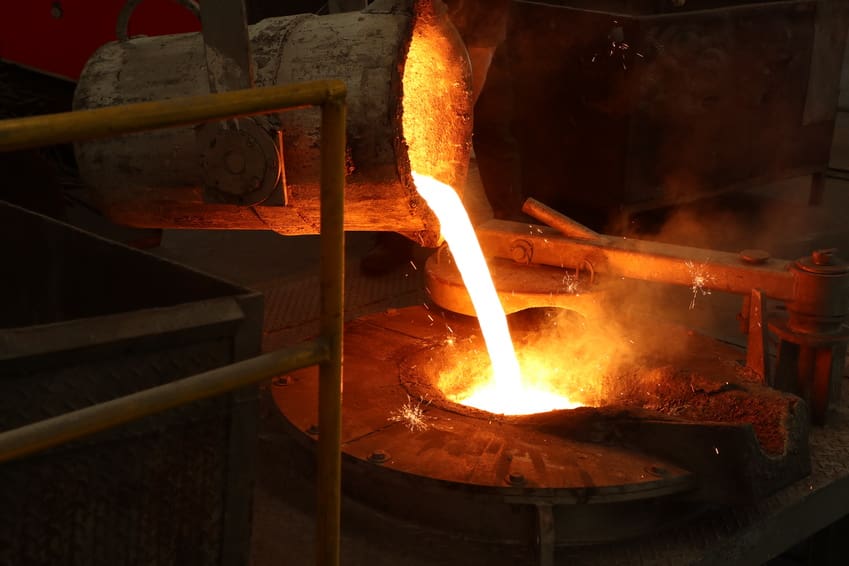
There are two main types of induction furnace: coreless and channel. Coreless induction furnaces
The heart of the coreless induction furnace is the coil, which consists of a hollow section of heavy duty, high conductivity copper tubing which is wound into a helical coil. Coil shape is contained within a steel shell. To protect it from overheating, the coil is water-cooled, the water being recirculated and cooled in a cooling tower. The crucible is formed by ramming a granular refractory between the coil and a hollow internal.
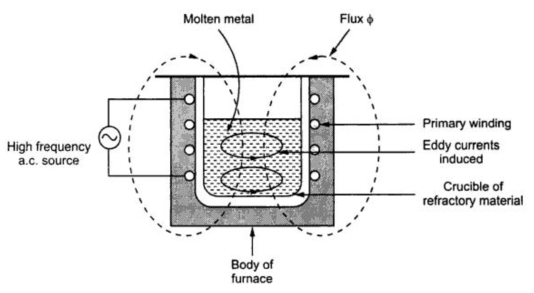
The coreless induction furnace is commonly used to melt all grades of steels and irons as well as many non-ferrous alloys. The furnace is ideal for remelting and alloying because of the high degree of control over temperature and chemistry while the induction current provides good circulation of the melt.
The channel induction furnace consists of a refractory lined steel shell which contains the molten metal. Attached to the steel shell and connected by a throat is an induction unit which forms the melting component of the furnace.
The induction unit consists of an iron core in the form of a ring around which a primary induction coil is wound. This assembly forms a simple transformer in which the molten metal loop comprises the secondary component.
.png)
The heat generated within the loop causes the metal to circulate into the main well of the furnace. The circulation of the molten metal effects a useful stirring action in the melt. Channel induction furnaces are commonly used for melting low melting point alloys and or as a holding and superheating unit for higher melting point alloys such as cast iron.
A foundry is a factory that produces metal castings. Metal are cast into shapes by melting them into a liquid, pouring the metal into a mould, and removing the mould material after the metal has solidified as it cools. The most common metals processed are Copper & Copper Alloy.
Melting is performed in a furnace. Virgin material, external scrap, internal scrap, and alloying elements are used to charge the furnace. Virgin material refers to commercially pure forms of the primary metal used to form a particular alloy. Alloying elements are either pure forms of an alloying element, like electrolytic nickel, or alloys of limited composition, such as ferroalloys or master alloys. External scrap is material from other forming processes such as punching, forging, or machining. Internal scrap consists of gates, risers, defective castings, and other extraneous metal oddments produced within the facility.
The process includes melting the charge, refining the melt, adjusting the melt chemistry and tapping into a transport vessel. Refining is done to remove deleterious gases and elements from the molten metal to avoid casting defects. Material is added during the melting process to bring the final chemistry within a specific range specified by industry and/or internal standards. Certain fluxes may be used to separate the metal from slag and/or dross and degassers are used to remove dissolved gas from metals that readily dissolve certain gasses. During the tap, final chemistry adjustments are made.
Copper is one stubborn metal that has a high melting point reaching up to 1,085°C
The conventional way of melting copper is through the use of large-scale equipment for mass producing great quantities of copper, such as induction furnaces and foundries.
However, with the widespread availability and practicality of copper a new, smaller-scale technique in melting copper has emerged. We no longer have to invest in expensive equipment that are only to be handled by trained metalworkers. Instead, we are going to take a look at an easier method which anyone can use.
There are various ways to melt copper, and each method uses a particular type of container and heating element that may be different from other methods. We are going to tackle the simplest, most efficient way on how to melt copper in an ordinary house setting, which is through the use of an oxyacetylene torch and a stovetop
